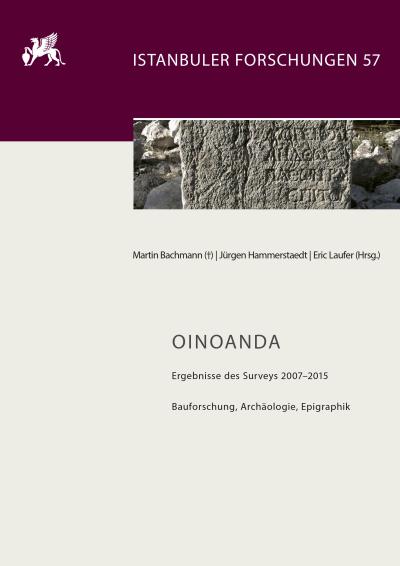
Oinoanda: Ergebnisse des Surveys 2007–2015: Bauforschung, Archäologie, Epigraphik
https://doi.org/10.34780/pd9c-1dcy
Synopsis
The publication presents the results of a survey conducted between 2007 and 2015 at Oinoanda, an ancient city in Lycia, Southern Turkey, in collaboration between the German Archaeological Institute Istanbul and the University of Cologne. Located on the city's acropolis, impressive buildings and monuments spanning nearly 1000 years of settlement history from the Hellenistic to Byzantine periods have been preserved. The investigation employed a combination of interdisciplinary research approaches including archaeology, architectural study, geophysics, and epigraphy. Additionally, new digital documentation and analytical methods at the intersection of epigraphy and architectural research were applied to the city's most significant inscription, also the largest known inscription of the Greco-Roman antiquity. Its author, Diogenes of Oinoanda, erected it in the 2nd century AD in the city center to advocate Epicurean philosophy to its readers.
Available in open access from June 2027
Keywords:
Archaeology, Building history, Epigraphy, Antiquity, Asia Minor, History of philosophy, Diogenes of OinoandaChapters
-
Vorwort
-
1 Überblick über das Gesamtvorhaben
-
1.1 Einleitung – Ausgangspunkte des Surveyprojektes in Oinoanda
-
1.2 Überblick zur Topographie und Geschichte der Stadt
-
1.3 Ältere Forschungen
-
1.4 Die frühen Forschungen zum Umland – die britischen Forschungen extra muros und der Balbura Survey
-
1.5 Offene Forschungsfragen in Oinoanda und konzeptionelle Architektur des Surveyprojektes
-
1.6 Methoden der Stadtplanaufnahme und des Gebäudeaufmaßes
-
1.7 Möglichkeiten und Grenzen eines virtuellen Stadtmodells des Esplanadebereiches von Oinoanda
-
2 Die Esplanade (ältere Agora) und ihre Umgebung
-
2.1. Das Platzareal und seine Umgebungsbauten
-
2.2 Die Nordstoa der Esplanade
-
2.3 Die frühbyzantinische Südstoa 3 und ihre Vorgängerbauten
-
2.4 Der Pseudoperipteralbau an der Esplanade
-
2.5 Die statuarischen Monumente bzw. Ehrenmonumente auf der Esplanade
-
2.6 Resümee: Funktion und chronologische Entwicklung der Platzanlage
-
3 Der zentrale Stadtbereich
-
3.1 Überblick
-
3.2 Die Straßenstoa an der Nordoststraße, die Antoninische Therme und das Viertel um die (jüngere, hochkaiserzeitliche) Agora
-
3.3 Das ›vespasianische‹ Badehaus und das angrenzende Bogenmonument (Vespasiansbogen)
-
3.4 Die Felsbebauung des sog. Martin’s Hill
-
3.5 Die Hauptkirche
-
3.6 Die Südstraße von der Agora zum Säulenstraßentor; Südkirche
-
4 Die Befestigungsbauten
-
5 Stadträumliche Bereiche des zivilen Lebens
-
6 Entwicklung architektonischer Ornamente in Oinoanda als Indikator für Globalismus und Glokalismus
-
7 Die nähere Umgebung des Stadtareals und zur Chora von Oinoanda
-
8 Neue nicht-philosophische Inschriften aus Oinoanda
-
9 Zur Diogenesinschrift
-
9.1 Die epikureische Inschrift des Diogenes von Oinoanda
-
9.2 Die Diogenesinschrift – neue Rekonstruktionsansätze
-
9.3 Methodik der Inschriftendokumentation
-
Epilog und Ausblick
Published
November 25, 2025
Series
Bibliographic Information and Reviews
Copyright (c) 2025 Deutsches Archäologisches Institut