The Village Gymnasium at Philoteris/Watfa in the Fayum
https://doi.org/10.34780/k07xr378
Synopsis
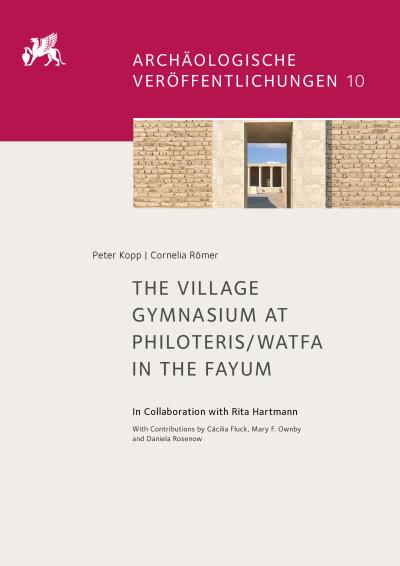
The gymnasium excavated in the ancient village of Philoteris in the Fayum Oasis is the first building of its kind attested in the archaeological record in Egypt. It is thus unique and provides novel and deeper insight into one aspect of the communal life of Egyptian settlers and Hellenised immigrants in Egypt in the 3ʳᵈ century B.C. up to the Roman Period.
It has long been known, but until now only from textual sources, that gymnasia had been established throughout Egypt in those places where the first Ptolemaic kings had settled Hellenic soldiers during the 3ʳᵈ century B.C. Particularly in the Fayum Oasis, thousands of people from across the Hellenised Mediterranean region came together. Apparently, many in these villages wanted to emphasise their cultural background by privately founding and funding gymnasia. The majority of the population, mainly comprising indigenous Egyptians, was presumably excluded from membership in these club-like institutions.
The excavated gymnasium was probably founded in the second half of the 3ʳᵈ century B.C. and abandoned when Roman rule in Egypt in the 1ˢᵗ century B.C. restricted gymnasia to the large cities.
The building construction consists of a central courtyard with surrounding structures, including a large assembly hall, a dining room, and probably at least one small lecture hall. The complex is surrounded by a mudbrick wall and was entered through a limestone gate, giving the gymnasium the appearance of an Egyptian temple from the outside. Next to it was the racecourse, which was more than 180 m long, in line with the Olympic stadium. All of this was within sight of the village but distinctly separated from it by a large canal.
Keywords:
Hellenistic Egypt, first gymnasium ever excavated in Egypt, village life in the Fayum Oasis, multicultural societyChapters
-
Preface
-
1. General Introduction
-
2. Introduction to the Archaeology of the Gymnasium
-
3. The Preceding Building(s)
-
4. The Entrance Gate (R01)
-
5. The Entrance Corridor (R02)
-
6. The Loutron (R15)
-
7. The Auditoria (R03 and R14)
-
8. The Central Courtyard = the Palaestra (R04)
-
9. The Main Hall = Exedra (R10)
-
10. The Banquet-Hall (R09)
-
11. Other Yards and Rooms (R05, R07)
-
12. The Racetrack
-
13. The Water Conduit from Canal I
-
14. Building Techniques and Materials
-
15. Architectural Elements Not Found In Situ
-
16. A Greek Inscription Dating to the Reign of Trajan
-
17. Lamps
-
18. Textile Remnants
-
19. Various Small Finds
-
20. Glass Vessel
-
21. Hand Mill
-
22. The Pottery Inventory of the Gymnasium at Philoteris/Watfa
-
23. Petrographic Analysis of Ptolemaic and Early Roman Pottery from Philoteris/Watfa
-
Bibliography
-
Image Credits
Published
August 24, 2025
Bibliographic Information and Reviews
Copyright (c) 2025 Deutsches Archäologisches Institut